


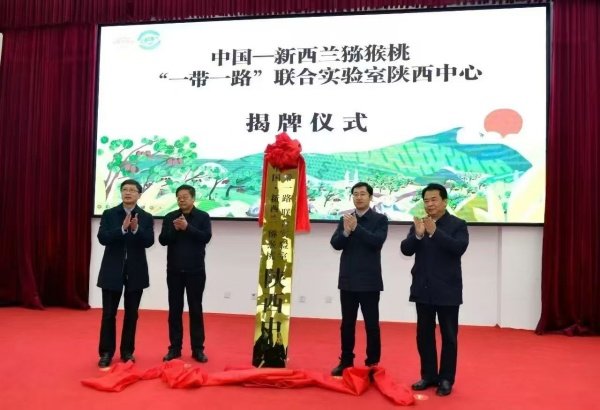
On 20 February 2023 the Shaanxi centre of the China–New Zealand Kiwifruit Belt and Road Joint Laboratory was unveiled in Zhouzhi, the county where our orchards and packing house sit. Xinhua reported the event that week, and the county government has cited the date in its own documents since. Anyone shipping kiwifruit out of this county has a stake in what it means.
Where the laboratory comes from
The parent laboratory dates to November 2014, when it was established in New Zealand. In October 2020 the Ministry of Science and Technology approved it into the second national batch of Belt and Road joint laboratories. Hongyang came out of its breeding work, the first commercial red-fleshed kiwifruit variety anywhere, and its red and yellow flesh selections have since spread well past China.
Nobody chose Zhouzhi at random. It grows more kiwifruit than any other county in the country, and it does so on the northern foot of the Qinling. Across greater Xi’an roughly 28,800 hectares go into vines, and about 550,000 tonnes come off them each year, near a fifth of China’s crop and close to a tenth of the world’s. Trial rows sit ten minutes from the blocks they are supposed to improve.
At the ceremony, Pei Jingyu, head of the Xi’an Agriculture and Rural Affairs Bureau, said the landing marked a step up for the county’s industry development, technology innovation and international cooperation. That line comes from the Xinhua report filed that day, not from anything written here.
What it changes for the fruit on your pallet
Variety work is the slowest link in this whole chain. A cross made now reaches a commercial block years later, and reaches a container after that. Selections moving through a national platform get tested against local conditions before any of them reach planted acreage, so nothing promising sits idle waiting for someone to notice it.
Trial plots and demonstration orchards have gathered around the site since opening too. Growers we buy fruit from farm within a short drive of it, and their technicians can attend training there. The county grew a research footprint in 2023 that was not there in 2020.
Our own breeding runs on the same logic
We begin at the germplasm too. Wild Qinling material comes in and gets crossed, and then we watch what comes out of it, generation after generation, standing in the field. Cold tolerance is what we select for, plus resistance to disease, plus the short stress windows a north facing slope hands a vine in a poor year.
Behind our nursery there are twenty years of exactly that. Virus-free seedlings come out of stem tip culture, grafted onto seedling rootstock raised from Qinling material. Every scion is cut from our own mother orchard, and purity gets checked there rather than found wanting two years later down at the shed.
So the fruit we send out reflects local selection rather than a page from a catalogue. Cuixiang, Xuxiang and Ruiyu were picked for this valley in particular, and a buyer notices the difference once somebody cuts one open.